

Andromeda Galaxy: The Closest Giant to the Milky Way and Our Future Cosmic Neighbor
The Andromeda Galaxy is not just a faint blur in the night sky. It is a massive spiral galaxy racing toward us. It holds nearly a trillion stars. And one day, it will merge with our own Milky Way. When you look up and search for the Andromeda Galaxy, you are not just studying space. You are looking at our future.
For centuries, people have watched this soft patch of light without knowing what it truly was. Today, however, we understand its size, structure, motion, and destiny. So now, let us explore what makes the Andromeda Galaxy one of the most important objects in the universe.
What Is the Andromeda Galaxy?
The short answer


The Andromeda Galaxy, also known as Messier 31 (M31), is the nearest large spiral galaxy to the Milky Way. It lies about 2.5 million light-years from Earth. Although that sounds far, in cosmic terms, it is close.
In fact, it is the most distant object you can see with the naked eye under dark skies.
It is similar in shape to our galaxy. It has:
However, it is larger than the Milky Way. Scientists estimate it may contain up to one trillion stars. That is more than double the number in our galaxy.
For detailed scientific data, you can explore NASA’s official Andromeda page:
https://science.nasa.gov/mission/hubble/science/explore-the-night-sky/hubble-messier-catalog/messier-31/
Why Is the Andromeda Galaxy So Important?
Key details
The Andromeda Galaxy matters because it helps scientists understand galaxy formation, dark matter, and cosmic evolution.
1. It Is Our Galactic Neighbor
First, it is part of the Local Group. This is a cluster of more than 50 galaxies, including:
Because Andromeda is close, astronomers can study its structure in detail. As a result, they learn more about how spiral galaxies grow and change.
2. It Is Moving Toward Us
Here is something remarkable.
The Andromeda Galaxy is moving toward the Milky Way at about 110 kilometers per second. Therefore, in about 4 to 5 billion years, the two galaxies will collide.
Do not worry. Stars are so far apart that most will not crash. Instead, the galaxies will slowly merge and form a new giant elliptical galaxy.
This future event gives scientists a rare chance to predict cosmic evolution.
Structure of the Andromeda Galaxy
Understanding structure of the andromeda galaxy
Although it looks calm from Earth, the Andromeda Galaxy is dynamic and complex.
H3: Central Bulge
At its center lies a supermassive black hole. In fact, it is much larger than the black hole at the center of the Milky Way.
The core is bright and densely packed with older stars.
H3: Spiral Arms
The spiral arms stretch outward and contain gas, dust, and young stars. These regions are active star-forming zones.
Because of this, astronomers study these arms to understand how new stars are born.
H3: Dark Matter Halo
Surrounding the visible galaxy is a massive halo of dark matter. Although we cannot see it directly, its gravitational pull affects how the galaxy rotates.
Therefore, Andromeda matters for dark matter research.
Can You See the Andromeda Galaxy?
What this means for you
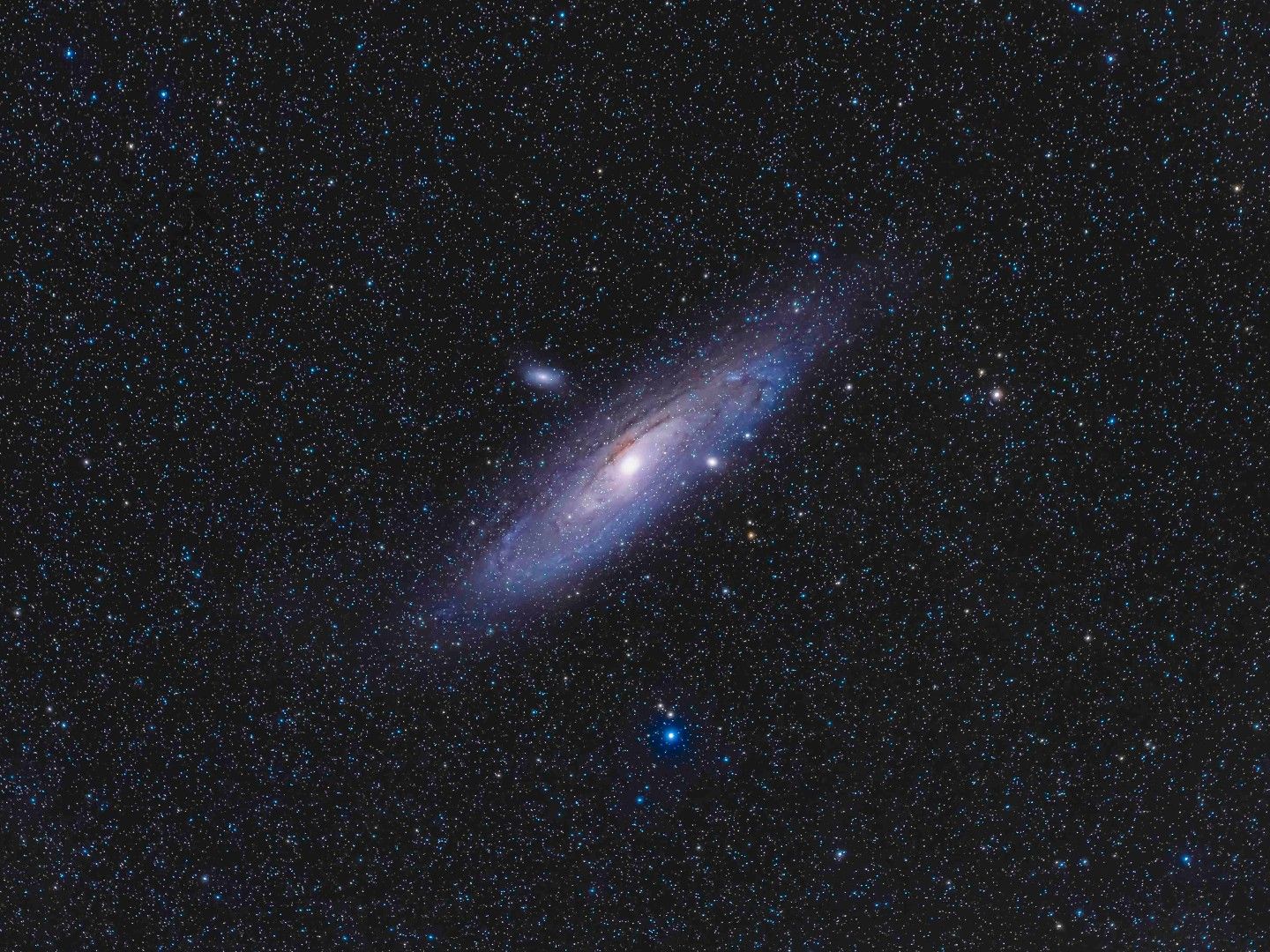


Yes, you can.
However, you need dark skies away from city lights.
How to Find It:
That patch is the Andromeda Galaxy.
With binoculars, you can see more detail. With a small telescope, you can observe its bright core and extended disk.
Therefore, even amateur astronomers can connect with another galaxy.
How Big Is the Andromeda Galaxy?
The short answer
The Andromeda Galaxy stretches about 220,000 light-years across. That makes it larger than the Milky Way, which is about 100,000 light-years wide.
However, size is not just about width. It is also about mass.
Recent studies suggest that the Milky Way and Andromeda may have similar total mass when dark matter is included.
Because of this, scientists continue to debate which galaxy is truly bigger.
What Will Happen When Andromeda Collides with the Milky Way?
Key details
The future collision sounds dramatic. Yet, it will unfold slowly over billions of years.
First, the galaxies will pass through each other. Then, gravity will pull them back together. Finally, they will merge into a single massive galaxy.
During this process:
The main points are a bright central bulge, wide spiral arms, billions of stars and dust lanes and star-forming regions. The main points are the Milky Way, the Triangulum Galaxy and many dwarf galaxies. The main points are look for the constellation Andromeda, use the Great Square of Pegasus as a guide and find a faint, fuzzy patch of light. The main points are new stars will form, gas clouds will compress and galactic shapes will distort. The main points are how exactly did it grow so large?, why does it show signs of past galactic mergers? And how is its star formation rate changing?.
Eventually, a new galaxy, sometimes called “Milkomeda”, will emerge.
This event reminds us that the universe is not static. It is always changing.
Andromeda Galaxy and Black Hole Research
Understanding andromeda galaxy and black hole research
The center of Andromeda contains a supermassive black hole. Studying it helps scientists compare galactic cores.
If you are curious about how black holes behave and even how scientists interpret cosmic sound data, you can explore this related topic:
👉 https://spacem12.com/sound-of-a-black-hole/
Understanding black holes helps explain the behavior of entire galaxies.
What Scientists Still Do Not Know
What this means for you
Even though we have studied the Andromeda Galaxy for decades, many mysteries remain.
For example:
Recent telescope observations reveal hidden structures in its outer halo. These structures suggest Andromeda absorbed smaller galaxies in the past.
Therefore, its history is more violent than it appears.
Andromeda Galaxy in Human History
Understanding andromeda galaxy in human history
Long before telescopes, ancient astronomers saw Andromeda as a faint cloud.
In 964 AD, Persian astronomer Abd al-Rahman al-Sufi described it as a “small cloud.”
However, it was not until the 1920s that astronomer Edwin Hubble proved it was outside the Milky Way.
That discovery changed our understanding of the universe forever.
Suddenly, the universe was much larger than we imagined.
Frequently Asked Questions (FAQs)
How far away is the Andromeda Galaxy?
The Andromeda Galaxy is about 2.5 million light-years from Earth.
Is Andromeda bigger than the Milky Way?
Yes, it is wider in diameter. However, total mass comparisons are still debated.
Will the Andromeda Galaxy destroy Earth?
No. Although the galaxies will merge, the vast distances between stars mean direct collisions are unlikely.
Can I see the Andromeda Galaxy without a telescope?
Yes. Under dark skies, it appears as a faint, blurry patch visible to the naked eye.
When will Andromeda collide with the Milky Way?
Scientists estimate the collision will begin in about 4 to 5 billion years.
Conclusion: A Glimpse of Our Cosmic Future
The Andromeda Galaxy is not just another object in space. It is our nearest giant neighbor. It is a laboratory for studying galaxy formation. And one day, it will become part of our own galactic home.
When you look at it tonight, remember this: you are seeing light that began its journey 2.5 million years ago.
You are seeing history.
And at the same time, you are looking at the future of the Milky Way.
That is the quiet power of the Andromeda Galaxy.

Muzamil
My name is Muzamil, and I am the founder of Spacem12 — a space exploration platform born out of a lifelong fascination with the cosmos. Like many who look up at the night sky and feel something stir, my passion for space began not in a classroom or a laboratory, but simply through curiosity. As a dedicated hobbyist, I found myself spending countless hours reading about rocket launches, distant galaxies, planetary missions, and the extraordinary people who dedicate their lives to exploring the unknown. Over time, I realized that much of the most exciting space content was either too technical for everyday readers or scattered across dozens of different sources. I started Spacem12 to change that — to create a single destination where anyone, regardless of their background, can explore the wonders of the universe in a clear, engaging, and accurate way. Spacem12 is built on the belief that space belongs to everyone. Whether you're a student discovering astronomy for the first time, a curious mind following the latest missions, or a fellow enthusiast who simply can't stop watching rocket launches — this site is for you. The universe is vast. The journey is just beginning.
View all posts

