What Is 1 Light Day? Space Distance and Communication Explained
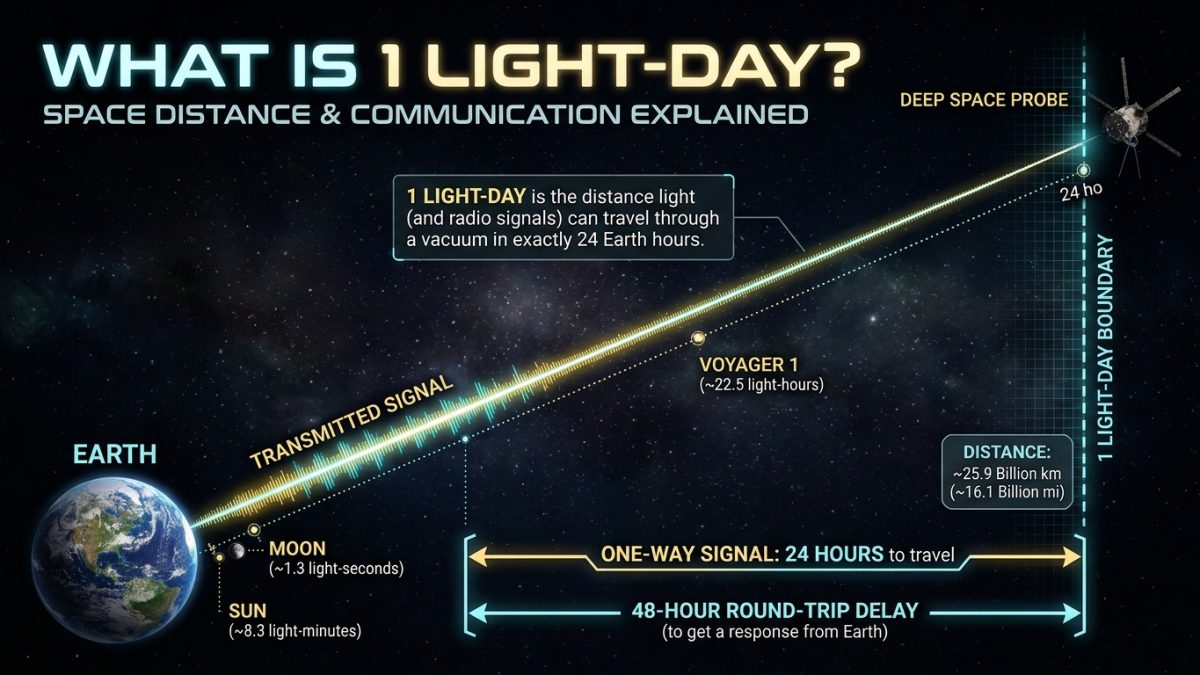
Many stargazers assume that deep space distances always use light years, but 1 light day is an essential unit for tracking human probes across our solar system. In simple terms, a light day represents the exact distance a beam of light travels through empty space during a full twenty-four-hour period. That distance spans about 16.09 billion miles, which equals roughly 25.9 billion kilometers. Scientists track this metric because it instantly reveals how long radio signals take to reach an outbound spacecraft. Because deep-space exploration pushes machines farther from Earth every year, this measurement has become a major milestone for human engineering.
People often mix up time with physical distance when they first hear terms based on light speed. For example, hearing the word day might make someone picture hours on a clock rather than a vast spatial gap across the cosmos. However, light moves at a set velocity of roughly 186,282 miles per second in a vacuum. So, multiplying that rapid speed across eighty-six thousand four hundred seconds produces a massive physical length. This vast scale dwarfs every planetary orbit that circles our Sun.
To put this expanse in perspective, Earth sits only eight light minutes away from the Sun. Even Pluto, which rests in the cold outer fringe of the planetary system, averages only around five and a half light hours from Earth. Therefore, reaching an entire light day requires traveling far beyond the classic planetary neighborhood. Spacecraft must cross the Kuiper Belt and push deep into the scattered disk to hit that mark. In fact, humanity has launched only a handful of probes capable of ever approaching such a remote boundary.
Engineers and astronomers face a unique choice when they report these deep-space voyages to the public and track telemetry. They can present distance using light travel time, or they can use traditional astronomical units and billions of miles. While light-time units show communication latency immediately, physical distance units make geometric orbital maps much simpler to calculate. Both metrics serve distinct purposes in mission control rooms around the world. Because each system highlights different facts, comparing them helps us understand how robotic pioneers navigate the dark void.
This detailed guide breaks down how a single light day works as a practical unit of measurement alongside standard astronomical metrics. We will examine what makes light-time so vital for communicating with probes like Voyager 1. Next, you will see how physical units compare when calculating navigation costs, mission efforts, and operational risks. Finally, you will learn which metric works best depending on whether your goal is calculating signal delays or charting celestial positions.
How Does 1 Light Day Compare to Astronomical Units for Deep Space?
Which Metric Should Observers and Engineers Pick?
Observers who want to understand communication delays should pick light-time units, while orbital dynamicists should rely on astronomical units. A light day tells an engineer exactly when to expect a reply from a distant automated transmitter. For instance, sending a ping across that gap requires twenty-four hours to arrive and another full day to return. On the other hand, an astronomical unit ties directly to Earth’s average distance from our Sun. As a result, calculating gravity assists and orbital trajectories stays cleaner when using standard distance units.
Why Do Both Measurements Coexist in Modern Astronomy?
Space agencies monitor both metrics simultaneously because physical location and data transmission create separate operational challenges. Deep-space flight requires precise coordinates relative to the Sun, which makes astronomical units ideal for tracking paths. Still, mission operators must schedule ground station antennas weeks ahead based on signal arrival schedules. Radio dishes cannot listen at the wrong hour without missing critical science telemetry. Therefore, pairing light days with orbital distances gives flight controllers a complete picture of the mission.

How Does 1 Light Day Work as a Practical Measurement?
What Is the Underlying Physics of Light-Time?
Light-time operates on the constant speed of electromagnetic radiation moving through a vacuum. Because radio signals travel at this identical speed, light-time directly mirrors the physics of interplanetary communication. You can discover more technical context through the NASA explanation of a light day and its physical meaning. When a probe reaches this threshold, any digital command sent from Earth takes a full twenty-four hours to hit the onboard computer. Thus, the physical gap automatically dictates the operational rhythm of the flight team.
Where Does This Distance Fall Inside the Solar System?
One light day sits at roughly one hundred and seventy-three astronomical units away from the Sun. This boundary lies far past the orbit of Neptune, well beyond the Kuiper Belt’s dense inner ring. In fact, this remote zone contains icy planetesimals and dormant cometary cores drifting in freezing silence. Spacecraft traveling through this sector encounter very little solar illumination, so solar panels become completely useless. Instead, probes must rely entirely on decaying nuclear fuel cells to keep their core electronics warm.
What Makes Reaching This Milestone Significant for Probes?
Reaching this frontier proves that a robotic explorer has survived decades of harsh radiation and micrometeoroid impacts. For decades, robotic craft like Voyager 1 have pressed outward into interstellar space to study magnetic fields. The milestone marks a transition where Earth is no longer just hours away by radio, but full days. Detailed reports, such as the CNN coverage on Voyager reaching a light day, highlight how rare this operational lifespan truly is. It stands as an undeniable benchmark for long-term mechanical endurance.
How Do Astronomical Units Work for Long-Range Tracking?
How Is an Astronomical Unit Defined?
An astronomical unit equals the average distance between the center of the Earth and the center of the Sun. Astronomers define this exact length as precisely 149,597,870,700 meters, or roughly ninety-three million miles. Because scientists base planetary orbits on this scale, it remains the standard measuring rod inside stellar systems. For example, Jupiter sits about five units out, while Saturn rests near nine and a half units. Consequently, every planetary chart uses this foundation to express relative spacing without using giant numbers.
Why Is It Useful for Mapping Orbits and Gravity?
Astronomical units simplify Keplerian orbital mechanics because planetary motions scale directly with this distance. When scientists calculate gravitational pulls or plan propulsion stages, using astronomical units keeps mathematical equations manageable. Rocket engineers who compare historic vehicles in studies like Starship vs Saturn V capabilities know that payload escape velocity directly determines how many units a probe can cover per year. So, celestial mechanics relies heavily on this standard to predict flybys accurately. Without it, mapping complex gravitational slingshots would require tedious unit conversions.
What Are the Practical Limits of Astronomical Units?
Although astronomical units work wonderfully for solar system mechanics, they lose intuitive meaning once distances become immense. Stating that an object sits at one hundred and seventy-three units tells the general public very little about radio contact. In addition, that number does not reveal how long an emergency reboot command will take to execute. As probes venture into the interstellar medium, astronomical units turn into large, abstract figures. That limitation makes time-based metrics far more relatable for human observers on Earth.

What Are the Critical Operational Differences Between the Two Systems?
How Does Communication Delay Impact Mission Planning?
Operating a spacecraft at light-day distances eliminates any possibility of real-time joystick control from ground stations. Flight teams must upload command sequences days in advance, trusting onboard automation to handle sudden anomalies. If an attitude control thruster misfires, the spacecraft must correct the error alone before mission control even hears the alarm. Tracking missions via resources like Orbital Radar deep space tracking demonstrates why latency dictates daily operations. Hence, light days quantify this operational risk far better than static physical miles ever could.
What Are the Tracking Costs and Antenna Scheduling Efforts?
Physical distance weakens radio signals according to the inverse-square law, demanding massive ground antennas to catch faint whispers. NASA’s Deep Space Network must align dish arrays spanning seventy meters across multiple continents just to pull data from that range. Scheduling those precious receiver hours requires exact calculations of when outbound waves cross into the antenna footprint. Astronomical units describe the signal’s physical attenuation across space. Meanwhile, light days tell planners the exact window when transmission begins and ends.
How Do Navigation Precision and Telemetry Results Compare?
Orbital navigators achieve higher positional accuracy by blending both metrics into their software pipelines. Ranging measurements send coded radio pulses to the probe, timing the return down to fractions of a microsecond. This precise timing gives engineers a direct light-time value that confirms the probe’s true distance. Then, flight software converts that light delay back into astronomical units to plot the trajectory against the celestial reference frame. As a result, both units work together to verify that the probe stays on its outbound course.
Which Distance System Should You Use for Space Analysis?
When Should Science Communicators Choose Light Days?
Science educators should pick light days whenever they want audiences to understand the immense emptiness of deep space. Telling someone that a vehicle is sixteen billion miles away usually produces blank stares because human minds cannot grasp billions. However, explaining that radio waves traveling at top cosmic speed need a full day to reach the probe makes the scale click. It creates an instant human connection to the machine’s absolute isolation. For this reason, popular space media relies on light travel time for major milestone announcements.
When Should Engineers Rely on Astronomical Units?
Aerospace engineers should stick to astronomical units whenever they model gravitational fields, solar wind density, or orbital trajectories. Solar radiation pressure and solar magnetic field strength decrease in direct mathematical relation to astronomical units. Because solar physics models build directly upon this foundation, switching to light-time would only add unnecessary conversion steps. Spacecraft designers use these units to size thermal insulation and select propulsion hardware for long voyages. Thus, technical documentation continues to prioritize astronomical units for hard engineering calculations.

Frequently Asked Questions
What is 1 light day in miles and kilometers?
One light day equals approximately 16.09 billion miles, which is about 25.9 billion kilometers. This number represents the total distance that light travels through a vacuum in twenty-four hours.
Has any human spacecraft traveled 1 light day from Earth?
Voyager 1 is the first human-made object to approach and cross the threshold of one light day from our planet. Launched in 1977, the robotic probe spent nearly half a century speeding outbound to achieve this rare milestone.
How many astronomical units make up 1 light day?
One light day equals roughly 173.14 astronomical units. Because one astronomical unit is the distance from Earth to the Sun, a light day is more than one hundred and seventy times greater.
Can radio signals travel faster than a light day in 24 hours?
No, radio signals are electromagnetic waves that travel at the speed of light through the vacuum of space. As a result, any signal sent to a spacecraft one light day away will always take exactly twenty-four hours to arrive.
Is 1 light day inside or outside the solar system?
A distance of one light day places an object in the interstellar medium outside the heliosphere, though still inside the distant Oort Cloud. While the Sun’s solar wind no longer dominates this region, its weak gravitational pull still extends much farther out.
Conclusion
The single most important fact to remember is that 1 light day is both a colossal physical span and a rigid communication boundary. It represents sixteen billion miles of empty space, but it also means every simple command requires a two-day round trip. While astronomical units remain superior for mapping celestial mechanics, light-time units reveal the true operational hurdles of interstellar flight. Both systems provide unique insights into how humanity explores beyond the familiar warmth of our Sun.
This overview could not cover every mathematical nuance of general relativistic time delays or subtle gravitational lensing effects that slightly alter signal paths. Those specific timing variations depend heavily on solar alignment and planetary positions along the line of sight. For readers interested in following this cosmic journey further, checking live telemetry logs on official space agency mission portals offers the best real-time view of humanity’s farthest explorers.

Muzamil
My name is Muzamil, and I am the founder of Spacem12 — a space exploration platform born out of a lifelong fascination with the cosmos. Like many who look up at the night sky and feel something stir, my passion for space began not in a classroom or a laboratory, but simply through curiosity. As a dedicated hobbyist, I found myself spending countless hours reading about rocket launches, distant galaxies, planetary missions, and the extraordinary people who dedicate their lives to exploring the unknown. Over time, I realized that much of the most exciting space content was either too technical for everyday readers or scattered across dozens of different sources. I started Spacem12 to change that — to create a single destination where anyone, regardless of their background, can explore the wonders of the universe in a clear, engaging, and accurate way. Spacem12 is built on the belief that space belongs to everyone. Whether you're a student discovering astronomy for the first time, a curious mind following the latest missions, or a fellow enthusiast who simply can't stop watching rocket launches — this site is for you. The universe is vast. The journey is just beginning.
View all posts