Guide to Stars and Nebulas: A Journey Through Cosmic History
A complete Guide to Stars and Nebulas explores the massive gas clouds and burning spheres of plasma that fill the night sky. Stars generate light and heat through nuclear fusion in their cores, while nebulas act as the vast interstellar nurseries where these luminous bodies are born. For centuries, stargazers have looked upward to map these glowing formations and understand their place in the wider cosmos. Modern telescopes now allow us to peer deep inside dusty stellar incubators, revealing secrets that were hidden from early astronomers. By studying both stars and nebulas, science unlocks the history of chemical elements and the ultimate fate of our universe.
Deep space contains vast expanses that look empty to the naked eye, but powerful lenses reveal glowing clouds of gas and dust scattered throughout the Milky Way. These stellar nurseries contain hydrogen, helium, and heavier elements forged by previous generations of dying suns. Gravity slowly pulls these ingredients together, compressing the material until temperatures rise high enough to ignite nuclear fires. Once a star turns on, it begins a long journey of shining brightly across the dark void of space. Eventually, that same star will return its material to the cosmos, feeding future nebulas in an endless cycle.
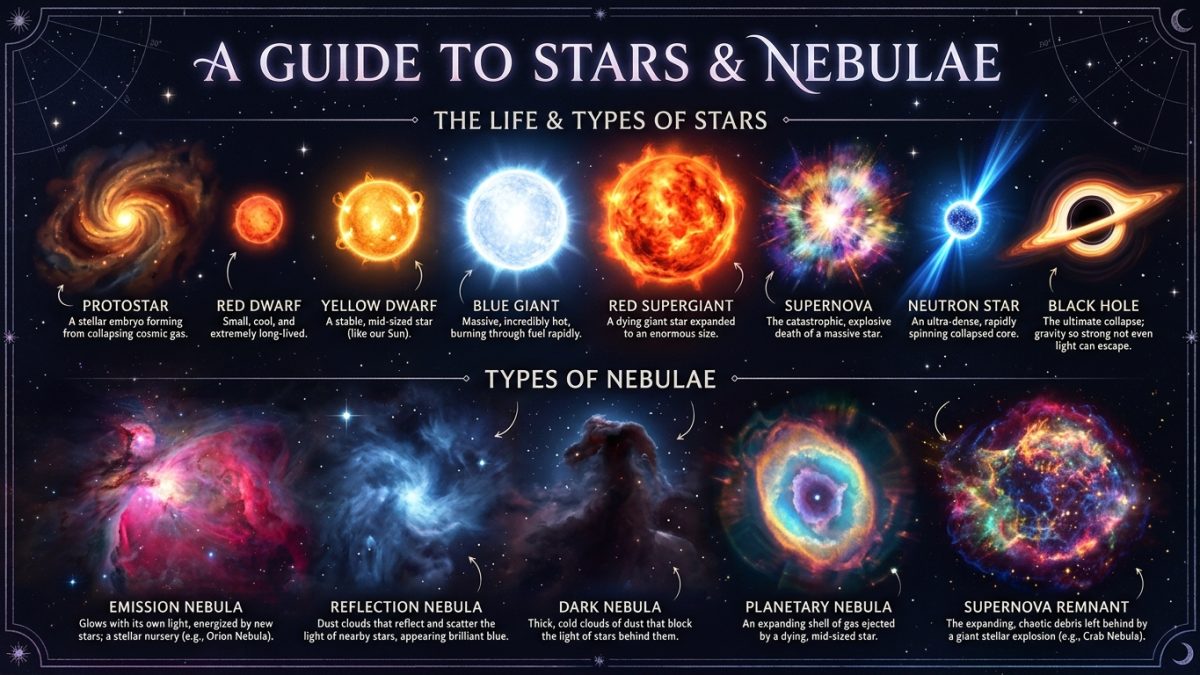
Stellar evolution governs every stage of a star’s existence, from a tiny protostar to a brilliant giant or a dense white dwarf. Smaller suns burn their fuel slowly, lasting for billions of years before fading into quiet obscurity. Massive stars burn through their fuel much faster, living short and dramatic lives that end in colossal explosions. These catastrophic events scatter heavy elements across interstellar space, seeding the clouds with carbon, nitrogen, and oxygen. Without this cosmic recycling program, rocky planets and living organisms could never form in the universe.
Astronomers categorize nebulas into several distinct types based on how they interact with starlight. Emission nebulas glow with their own light because nearby hot stars ionize the surrounding gas atoms. Reflection nebulas simply scatter the blue light of nearby stars, much like sunlight bouncing off fog particles on Earth. Dark nebulas block background starlight entirely, creating silhouettes of dense dust against the bright backdrop of the galaxy. Planetary nebulas represent the graceful outer layers shed by dying intermediate-mass stars, creating colorful shells of expanding gas.
Understanding these celestial mechanics gives humanity a deeper appreciation for our place in space. Every atom of iron in our blood and calcium in our bones was forged inside ancient stars that lived and died long ago. The universe is not a static collection of distant lights, but a dynamic system of creation and destruction. This guide will walk you through the physics, types, and life cycles of the most fascinating objects in the night sky. Prepare to journey through the stellar factories and glowing remnants that define our cosmic landscape.

What is the True Nature of Guide to Stars and Nebulas
Understanding the Basics of Stellar Physics
Stars are massive spheres of plasma held together by their own intense gravitational pull. At the center of every star, immense pressure forces hydrogen atoms to fuse into helium. This process, known as nuclear fusion, releases staggering amounts of energy in the form of light and heat. Photons generated deep inside the core take thousands of years to reach the surface and escape into space. Once they leave, they travel across the light years to reach our eyes.
The mass of a star determines its color, temperature, and total lifespan. Blue stars are extremely hot and burn through their fuel supply in a relatively short time. Red stars are much cooler and dimmer, but they can shine steadily for trillions of years. Our Sun sits comfortably in the middle as a yellow dwarf, providing a stable environment for life on Earth. As stars age, their internal structures change, causing them to expand and alter their energy output significantly.
The Anatomy of Interstellar Clouds
Nebulas are enormous accumulations of dust and gas drifting through the space between star systems. Most of this material consists of hydrogen gas, mixed with small amounts of helium and microscopic grains of heavier elements. These clouds can span dozens or even hundreds of light years across the galaxy. Although they look dense in long-exposure photographs, they are actually much thinner than the best laboratory vacuums on Earth. They appear opaque only because of their immense thickness.
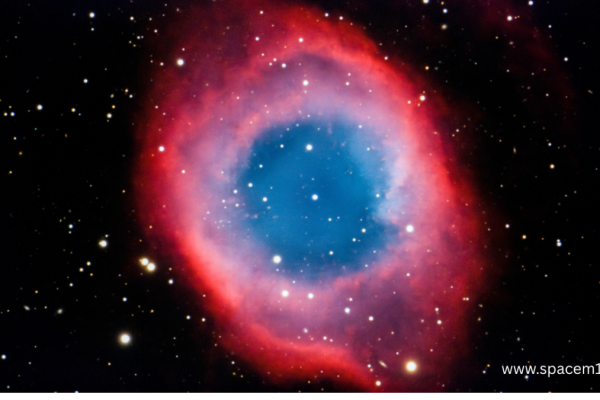
Gravity constantly acts upon these gas clouds, trying to pull the scattered atoms closer together. However, gas pressure and magnetic fields push back against gravity, resisting compression. When an external disturbance occurs, such as a nearby supernova shockwave, it compresses parts of the cloud. This compression triggers local collapses, forming dense pockets where new stars can finally begin to take shape. For more details on fascinating cosmic formations, check out this guide on the eye of god nebula.
The Interconnected Lifecycle
Stars and nebulas form an inseparable cycle of birth, life, and rebirth across cosmic time. Nebulas collapse to create stars, which then live out their natural lifespans over millions or billions of years. When those stars die, they eject their outer layers or explode violently back into the interstellar medium. This ejected material enriches the surrounding gas clouds with newly minted heavy elements. Subsequent generations of stars form from this enriched material, carrying a more complex chemical signature.
This recycling process explains why the early universe contained almost entirely hydrogen and helium. Heavier elements like gold, silver, and uranium only exist because previous stars manufactured them during their final moments. Therefore, every nebula in the modern galaxy contains a richer mixture of elements than the nebulas of the early universe. This ongoing evolution ensures that every new stellar generation is chemically distinct from the one before it.
Observing the Cosmos from Earth
For thousands of years, humans could only study stars and nebulas with the naked eye. Ancient astronomers recorded bright points of light and hazy patches that refused to resolve into single stars. The invention of the telescope changed everything, revealing that those hazy patches were actually huge glowing clouds of gas. Modern observatories now use multiple wavelengths of light, including infrared, ultraviolet, and X-rays, to peer through thick dust lanes.
Infrared telescopes are especially useful because they can see right through dense nebulas to observe newborn stars hiding inside. Amateur astronomers also contribute to this field by using backyard telescopes equipped with digital cameras and specialized filters. These tools allow enthusiasts to capture stunning details of distant star clusters and colorful gas clouds from their own backyards. The pursuit of astronomy connects everyday people to the vast history of the physical universe.
How Do Stars Form Inside Nebulas?
The Triggering of Gravitational Collapse
Star formation begins in the coldest and densest parts of giant molecular clouds. These regions contain temperatures just above absolute zero, which keeps the gas molecules moving slowly. Because the gas moves slowly, internal pressure drops and allows gravity to take control. Sometimes, a gentle nudge is all it takes to push a cloud fragment past its tipping point. This nudge often comes from the passing spiral arms of the galaxy or the wind from nearby hot stars.
As a pocket of gas starts to collapse, it breaks apart into smaller fragments, each destined to form a star. These fragments grow denser and hotter as they pull more surrounding material into their center. Conservation of momentum causes the collapsing gas to spin faster and faster as it shrinks. This spinning motion flattens the material into a swirling disk surrounding a central dense core. This swirling disk is the birthplace of future planetary systems.
The Protostar Phase
The central core of a collapsing gas fragment is known as a protostar before it ignites nuclear fusion. During this stage, the object glows purely from the heat generated by its own gravitational contraction. In fact, protostars are often surrounded by thick cocoons of dust that block visible light completely. Astronomers must use infrared instruments to detect the heat radiating from these hidden stellar embryos.
Powerful stellar winds often erupt from the poles of a young protostar, clearing out tunnels through the dust. These bipolar outflows help regulate the growth of the star by carrying away excess angular momentum. Without these jets of gas, the protostar would spin too fast and tear itself apart before fusion could begin. This energetic phase lasts for a relatively short time in astronomical terms.
Ignition of Nuclear Fusion
As more material falls onto the protostar, the core temperature and pressure climb to extreme levels. When the temperature reaches millions of degrees, hydrogen atoms begin to fuse into helium. This reaction releases a flood of energy that pushes outward against the inward pull of gravity. A delicate balance is achieved between gravity and thermal pressure, known as hydrostatic equilibrium.
Once this balance is reached, the protostar officially becomes a main sequence star. The surrounding dust disk continues to evolve, sometimes clumping together to form planets, asteroids, and comets. The fierce stellar wind from the newly born star eventually blows away the remaining envelope of gas. The star now shines brightly on its own, illuminating the remnant of the nebula from which it emerged.
The Variety of Newborn Stars
Not all stars that form inside a nebula turn out the same size or brightness. The mass of the original collapsing gas fragment dictates the final category of the resulting star. Low-mass fragments produce red dwarf stars, which are the most common type of star in the universe. High-mass fragments produce massive blue giants that dominate the visual appearance of distant star clusters.
When massive stars form in groups, their intense ultraviolet radiation quickly ionizes the surrounding nebula. This process creates glowing emission regions that can span hundreds of light years across space. Smaller stars lack the energy to ionize surrounding gas on such a massive scale, resulting in dimmer stellar nurseries. Every stellar cluster tells a unique story about the density and composition of its parent cloud.

What Are the Main Types of Nebulas?
Emission Nebulas and Ionized Gas
Emission nebulas glow brightly because nearby massive stars flood them with energetic ultraviolet radiation. This radiation strips electrons away from hydrogen atoms in a process called ionization. When these free electrons recombine with protons, they emit specific wavelengths of light. This creates the characteristic pink and red hues seen in many famous astronomical photographs.
Hydrogen is not the only element found in emission regions, as oxygen and sulfur also contribute their own colors. Narrowband filters allow astrophotographers to isolate these specific chemical signatures and produce detailed scientific images. These glowing clouds show astronomers where recent star formation has taken place in the galaxy. Studying them helps map the spiral structure and star-forming rate of distant stellar systems.
Reflection Nebulas and Starlight Scattering
Reflection nebulas do not emit their own light, but instead reflect and scatter starlight from nearby objects. The microscopic dust grains within these clouds are exceptionally good at scattering shorter wavelengths of light. Because blue light scatters much more easily than red light, these nebulas usually appear blue to human eyes. This is the exact same optical physics that makes the daytime sky on Earth look blue.
The stars illuminating reflection nebulas are typically not hot enough to ionize the surrounding gas atoms. Instead, they simply act as cosmic lanterns shining through a dusty fog. For instance, you can explore the intricate details of stellar reflection by examining the famous iris nebula secrets the enigma of celestial beauty. These delicate formations demonstrate how light interacts with microscopic matter across interstellar distances.
Dark Nebulas and Cosmic Silhouettes
Dark nebulas are dense clouds of interstellar dust that block out all visible light from stars behind them. They contain no nearby bright stars to illuminate their contents, making them appear as dark patches against the bright Milky Way. Famous examples, such as the Horsehead Nebula, stand out sharply because of their stark contrast. These regions are often the coldest and densest places in the galaxy.
Although they look empty and forbidding, dark nebulas are actually active sites of star creation. Their heavy shielding protects fragile molecules from being destroyed by harsh ultraviolet radiation from outside sources. Inside these dark sanctuaries, complex organic molecules and ice-coated dust grains thrive undisturbed. As gravity continues its work, new stars will eventually break out from these dark cocoons.
Planetary Nebulas and Stellar Remnants
Planetary nebulas have nothing to do with planets, despite their confusing historical name given by early observers. When a star with a mass similar to our Sun runs out of fuel, it swells into a red giant. Eventually, it gently sheds its outer atmospheric layers into space over thousands of years. The hot core left behind radiates intense ultraviolet light that causes the expanding gas shell to glow.
These glowing shells often display symmetrical patterns, rings, or delicate butterfly shapes as they drift outward. Our own Sun will experience this exact fate billions of years from now, transforming into a white dwarf surrounded by a glowing shroud. To see a striking example of this late evolutionary stage, take a look at the details of the helix nebula. These dying gas shells mark the final graceful chapter in the life of intermediate-mass stars.
How Do Stars End Their Lives?
The Peaceful Death of Low-Mass Stars
Low-mass stars, particularly red dwarfs, have incredibly long lifespans because they consume their nuclear fuel very slowly. A red dwarf can burn through its hydrogen supply over trillions of years without running out. Because the universe is still relatively young, no red dwarf has ever reached the end of its natural life. When they finally do run out of fuel, they will fade quietly into dark dwarves without dramatic explosions.
Intermediate stars like our Sun experience a more eventful retirement plan when their core hydrogen runs out. The core contracts and heats up, causing the outer layers of the star to expand dramatically. The star turns into a red giant, growing large enough to swallow the inner planets of its system. After shedding its outer layers into a planetary nebula, the remaining core becomes a dense white dwarf.
The Violent Death of Massive Stars
Massive stars burn through their nuclear fuel at an astonishing rate, lasting only a few million years before reaching crisis. When a massive star runs out of hydrogen, its core contracts and begins fusing heavier elements in successive shells. This process continues up the periodic table, producing carbon, neon, oxygen, silicon, and finally iron. Iron fusion does not release energy, but instead absorbs it, causing the core support to fail instantly.
Gravity crushes the iron core of the massive star in a fraction of a second, resulting in a colossal explosion. This explosion, known as a supernova, outshines an entire galaxy for a brief period of time. The shockwave rips through the outer layers of the star, scattering heavy elements far into interstellar space. This violent event is responsible for creating neutron stars and black holes.
Supernova Remnants and Neutron Stars
The expanding debris cloud left behind after a supernova explosion is called a supernova remnant. These expanding shells sweep up surrounding interstellar gas, creating complex web-like structures that glow across multiple wavelengths. The Crab Nebula is one of the most famous supernova remnants visible in our night sky today. It marks the site of a stellar explosion recorded by astronomers centuries ago.
At the very center of many supernova remnants lies a bizarre stellar corpse called a neutron star. A neutron star packs more than the mass of our Sun into a sphere only a few miles wide. Their gravitational and magnetic fields are so intense that they defy ordinary imagination. Some neutron stars spin rapidly, sweeping beams of radiation across space like cosmic lighthouses known as pulsars.
Black Holes and Extreme Physics
If a dying star is massive enough, the collapsing core cannot be stopped by neutron degeneracy pressure. Gravity continues to crush the matter inward until it occupies a single point of infinite density. This forms a black hole, a region of space where gravity is so strong that nothing can escape. Even light itself cannot travel fast enough to break free from the gravitational pull of a black hole.
Surrounding the black hole is an invisible boundary called the event horizon, marking the point of no return. Matter falling toward this boundary forms a glowing accretion disk that heats up through friction and X-ray emission. Studying these extreme objects helps physicists test the limits of general relativity and quantum mechanics. The death of a massive star thus gives birth to some of the most mysterious phenomena in the universe.

Frequently Asked Questions
What is the difference between a star and a nebula?
A star is a burning sphere of plasma producing its own energy through nuclear fusion. A nebula is a massive cloud of interstellar gas and dust where stars are born or where dying stars leave behind gas.
Can we see nebulas with the naked eye?
Most nebulas are too faint to see without optical equipment. However, a few bright ones, like the Orion Nebula, appear as hazy patches under dark night skies.
How long do stars live?
Stellar lifespans vary widely based on mass. They range from a few million years for massive blue stars to trillions of years for small red dwarfs.
What will happen to our Sun in the future?
Our Sun will eventually swell into a red giant and shed its outer layers. Afterward, it will form a planetary nebula and leave behind a cooling white dwarf.
Conclusion
Stars and nebulas form the dynamic engine that drives the chemical and physical evolution of the universe. From the quiet collapse of cold molecular clouds to the explosive death of massive suns, these celestial bodies shape our galaxy over billions of years. Studying their lifespans reveals how heavy elements spread through space and eventually form rocky worlds like Earth. Take time to look through a telescope or explore astronomical imagery to witness these cosmic wonders for yourself.

Muzamil
My name is Muzamil, and I am the founder of Spacem12 — a space exploration platform born out of a lifelong fascination with the cosmos. Like many who look up at the night sky and feel something stir, my passion for space began not in a classroom or a laboratory, but simply through curiosity. As a dedicated hobbyist, I found myself spending countless hours reading about rocket launches, distant galaxies, planetary missions, and the extraordinary people who dedicate their lives to exploring the unknown. Over time, I realized that much of the most exciting space content was either too technical for everyday readers or scattered across dozens of different sources. I started Spacem12 to change that — to create a single destination where anyone, regardless of their background, can explore the wonders of the universe in a clear, engaging, and accurate way. Spacem12 is built on the belief that space belongs to everyone. Whether you're a student discovering astronomy for the first time, a curious mind following the latest missions, or a fellow enthusiast who simply can't stop watching rocket launches — this site is for you. The universe is vast. The journey is just beginning.
View all posts