Helix Nebula: The Dying Star That Mirrors Our Sun’s Future
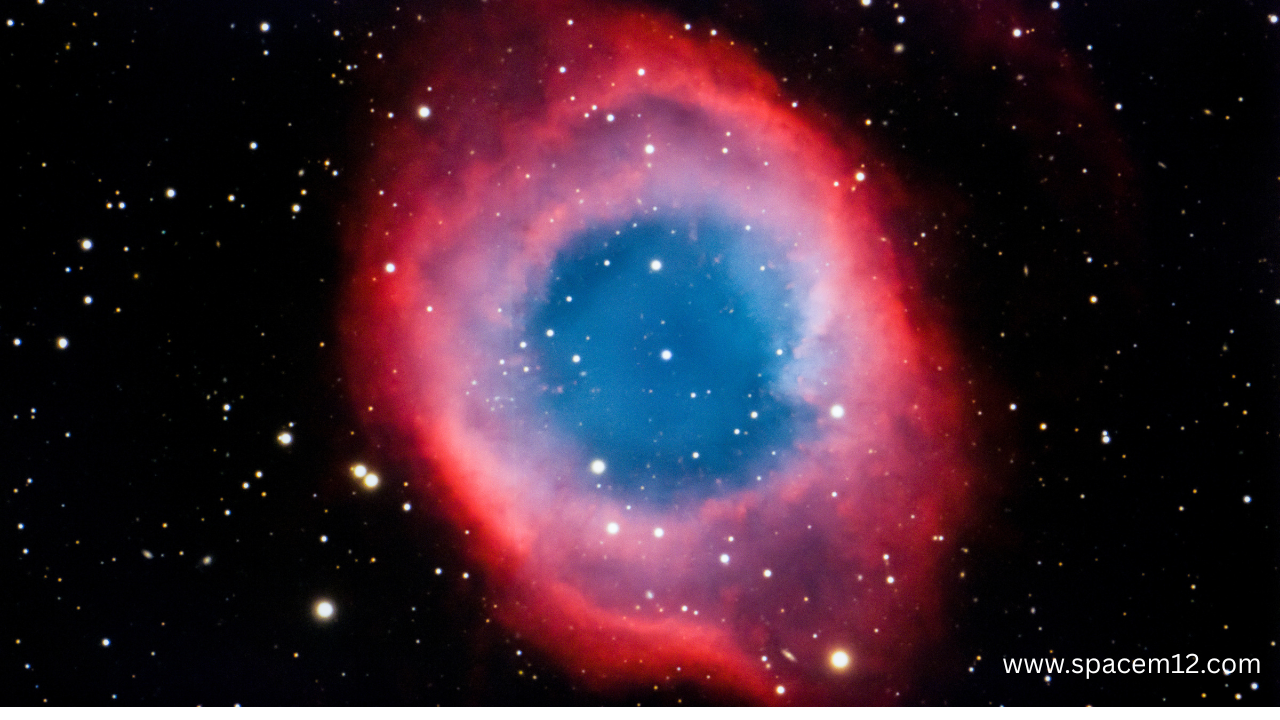
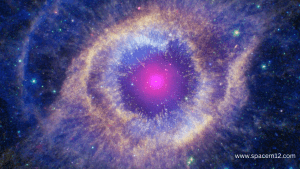
The Helix Nebula, also cataloged as NGC 7293, sits 650 light-years away in the constellation of Aquarius. Sometimes called the Eye of God, it is among the closest planetary nebulae to Earth. Its glowing form shows what happens when a medium-mass star exhausts its fuel. Scientists look at this cosmic cloud to better understand the fate awaiting our own Sun in about five billion years.
The Stellar Life Cycle
Stars spend most of their lives fusing hydrogen into helium. Over millions of years, fusion builds heavier elements like carbon, nitrogen, and oxygen. When the core runs out of fuel, the star sheds its outer layers in powerful waves. What remains is a white dwarf, a dense remnant as small as Earth but with incredible mass.
The Helix is one of the finest examples of this process. Its hot core bathes the surrounding gas in ultraviolet radiation, creating a glowing cloud visible across multiple wavelengths.
A Multiwavelength Masterpiece
Astronomers have studied the Helix using space observatories such as Spitzer, GALEX, and WISE. Infrared data reveals dusty shells, while ultraviolet images highlight the blazing heat of the white dwarf. Together, these observations show intricate structures shaped by stellar winds and ancient ejections.
The combined imaging proved the nebula is not just a simple ring. Instead, it contains two disks tilted at different angles, forming overlapping patterns of gas and dust.
Complex Cosmic Structures
Within the nebula lie hundreds of comet-like tendrils. These knots appear as radial spokes pointing outward. They are the result of hot gases colliding with cooler material expelled thousands of years earlier. Over time, these knots will dissipate, blending into interstellar space.
A dusty disk also circles the white dwarf at its core. This material likely came from comets disturbed during the star’s death. Collisions within this debris field continue to produce a faint but steady glow.
Observing the Helix
Amateur astronomers often target Caldwell 63, another name for the Helix, because of its brightness and size. With a magnitude of 7.3, it can be seen through binoculars under dark skies. From Earth, its diameter appears almost half that of the full Moon. Using a nebula filter enhances visibility, especially for those using small telescopes.
The object is best observed from the Southern Hemisphere in early spring, while northern observers can spot it in autumn. Its unique eye-like structure makes it a favorite for astrophotographers around the world.
Historical Discovery
German astronomer Karl Ludwig Harding first recorded the nebula in 1823. Since then, it has become one of the most studied planetary nebulae. Modern telescopes have continued to reveal new details, from infrared dust signatures to ultraviolet halos. Each discovery adds to our understanding of stellar death and the recycling of cosmic material.
Why It Matters
The Helix is more than just a celestial spectacle. Its expelled gases enrich the surrounding galaxy, seeding future stars and planetary systems. This recycling process shows how stellar death contributes to cosmic rebirth.
It also serves as a preview of the Sun’s own destiny. Inner planets will likely be destroyed, while outer bodies may be thrown into unstable orbits. What remains will be a glowing nebula surrounding a faint white dwarf at the heart of our solar system.
Case Study: NASA’s Multiwavelength View
NASA’s combined analysis of the Helix, using Spitzer’s infrared data and GALEX ultraviolet imaging, transformed our understanding of planetary nebulae. This study revealed the tilted disk structure and provided insight into cometary debris around dying stars.
🔗 Read NASA’s case study on the Helix Nebula
FAQs
Q1: Why is the Helix Nebula called the Eye of God?
Because of its round, eye-like shape, observers often describe it as resembling a cosmic eye staring back at Earth.
Q2: Can you see the Helix Nebula without a telescope?
Yes. Under dark skies, it can be spotted with strong binoculars, but details are only clear with telescopes.
Q3: What will happen to the Sun in the future?
In about five billion years, the Sun will expand, shed its outer layers, and leave behind a white dwarf surrounded by a planetary nebula similar to the Helix.
Q4: Who discovered the Helix Nebula?
It was first documented in 1823 by Karl Ludwig Harding, a German astronomer.
Q5: What makes the Helix special to astronomers?
Its close distance provides a clear view of planetary nebula features, helping scientists learn how medium-mass stars evolve.

Conclusion
The Helix Nebula is a living laboratory of stellar death and rebirth. Its glowing rings, dusty knots, and white dwarf core offer an extraordinary glimpse into the life cycle of stars. By studying it, astronomers not only understand the fate of distant systems but also glimpse the future of our own Sun.
✨ Want to explore more about cosmic wonders like the Helix Nebula? Dive into NASA’s research and stay connected with the latest space discoveries. The universe is waiting—don’t miss your chance to see it unfold.

Muzamil
My name is Muzamil, and I am the founder of Spacem12 — a space exploration platform born out of a lifelong fascination with the cosmos. Like many who look up at the night sky and feel something stir, my passion for space began not in a classroom or a laboratory, but simply through curiosity. As a dedicated hobbyist, I found myself spending countless hours reading about rocket launches, distant galaxies, planetary missions, and the extraordinary people who dedicate their lives to exploring the unknown. Over time, I realized that much of the most exciting space content was either too technical for everyday readers or scattered across dozens of different sources. I started Spacem12 to change that — to create a single destination where anyone, regardless of their background, can explore the wonders of the universe in a clear, engaging, and accurate way. Spacem12 is built on the belief that space belongs to everyone. Whether you're a student discovering astronomy for the first time, a curious mind following the latest missions, or a fellow enthusiast who simply can't stop watching rocket launches — this site is for you. The universe is vast. The journey is just beginning.
View all posts