Olympus Mons: The Giant Volcano That Reigns Over the Solar System
Imagine standing at the edge of a mountain so vast, so immense, that it would swallow entire countries on Earth and still leave room for more. That’s not fantasy — that’s Olympus Mons on Mars. In the realm of cosmic wonders, Olympus Mons is more than just a mountain — it’s the largest volcano in the solar system and a breathtaking testament to the power of nature beyond Earth. (Encyclopedia Britannica)

What Is Olympus Mons?
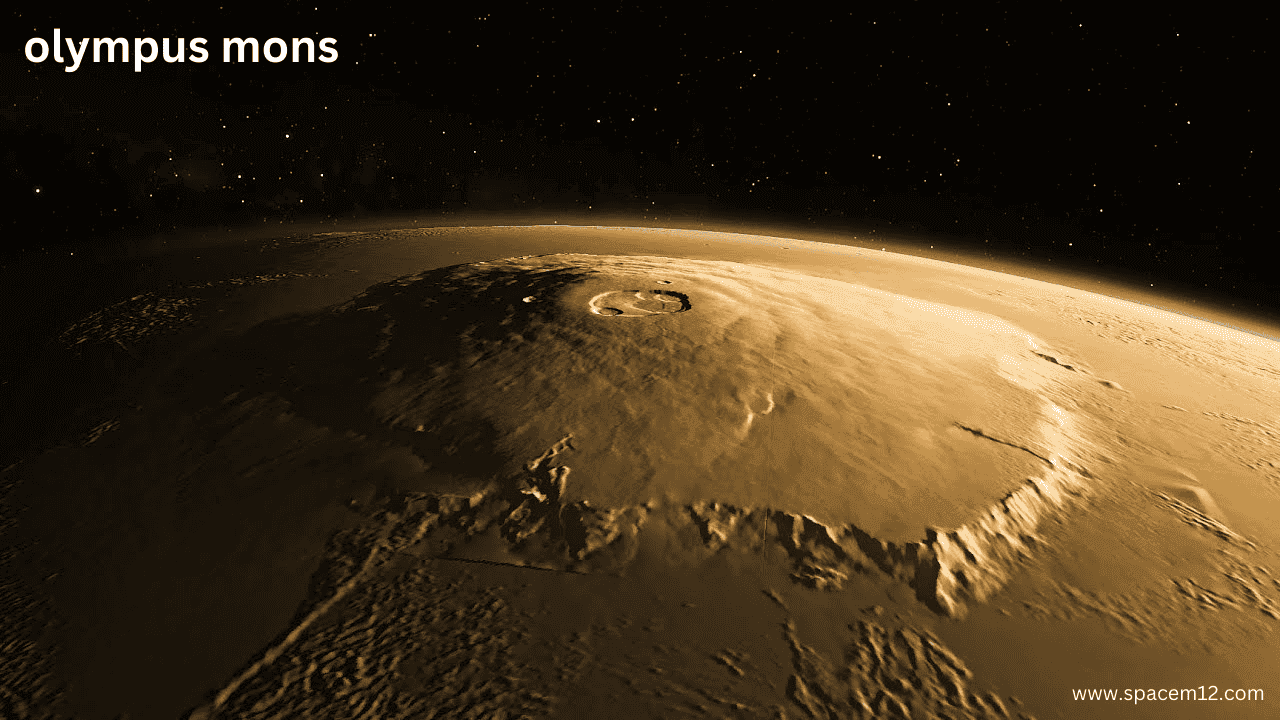
At its core, Olympus Mons is a shield volcano — a volcano built from gentle lava flows that spread over enormous distances. Unlike the explosive, cone-shaped volcanoes you might picture on Earth, shield volcanoes are broad and sweeping. But Olympus Mons takes this form to an unimaginable scale. (Wikipedia)
Here’s what makes it extraordinary:
- 🌋 It rises about 21–22 kilometers (13–14 miles) above the Martian surface, making it roughly 2.5 times taller than Earth’s highest peak, Mount Everest. (Wikipedia)
- 📏 Its base stretches across nearly 600 kilometers (370 miles) — that’s roughly the size of a large country. (Wikipedia)
- 🏔️ A massive caldera — a collapsed volcanic crater about 85 kilometers (53 miles) wide — sits at the summit. (Encyclopedia Britannica)
These numbers may be hard to picture, but when you do, you start to grasp how colossal this Martian giant truly is.
How Did Olympus Mons Grow So Huge?
On Earth, volcanoes usually don’t grow into giants like Olympus Mons because of something called plate tectonics — the slow shifting of Earth’s crust. When tectonic plates move, volcanic hotspots don’t stay in one place long enough to build up massive mountains. (Wikipedia)
Mars is very different:
- 🪨 No shifting plates: The Martian crust stays still over volcanic hotspots, allowing lava to erupt from the same spot for millions — even billions — of years. (Wikipedia)
- 🌋 Low gravity: Mars’ gravity is weaker than Earth’s, so lava can pile up higher without collapsing under its own weight. (Wikipedia)
- 🍃 Less erosion: With a thin atmosphere and no water like Earth has, Mars doesn’t wear down its mountains as quickly. (Space)
Together, these factors gave Olympus Mons all the time and space it needed to grow into the iconic peak we see today.
What Does Olympus Mons Tell Us About Mars?
Learning about Olympus Mons isn’t just cool trivia — it opens a window into Mars’ past and maybe even its future:
H3: Clues About Mars’ Geological History
The gentle, sprawling slopes of the volcano show that Mars once had long-lasting volcanic activity. Scientists study its layers to trace back ancient eruptions. (Space)
H3: Implications for Future Exploration
Recent observations suggest scientists are still finding surprises atop Olympus Mons. New studies hint at unique geological features at its summit, challenging earlier ideas about Mars’ volcanic life cycle and raising questions about whether Martian volcanoes might have been active more recently than we thought. (The Times of India)
Mars vs. Earth — How Do They Compare?
If you stood at the base of Olympus Mons, you wouldn’t feel like you’re at the foot of a steep, towering cliff. Its slopes are so gentle that they would look more like rolling plains — even though they’re taller than any mountain on Earth. (Space)
Here’s a quick comparison:
| Feature | Olympus Mons | Mount Everest |
|---|---|---|
| Height | ~21–22 km | ~8.8 km |
| Type | Shield volcano | Fold mountain |
| Base Size | ~600 km across | ~20 km across |
| Slope | Very gentle | Steep |
This contrast highlights how differently planets can shape their landscapes based on gravity, atmosphere, and geological forces.
FAQs About Olympus Mons
Q1: Is Olympus Mons still active?
A: Past research indicates it hasn’t erupted for millions of years, but some features suggest it could have been active more recently than previously assumed. (Space)
Q2: Could humans climb Olympus Mons?
A: In theory, yes — but the Martian gravity, atmosphere, and distance would make the journey extremely challenging for explorers. (Wikipedia)
Q3: Why does Mars have such huge volcanoes?
A: Because Mars lacks moving tectonic plates, volcanoes like Olympus Mons can keep erupting over the same spot without interruption. (Wikipedia)

Conclusion — A Monument of the Red Planet
Olympus Mons isn’t just another mountain — it’s a silent titan that has watched Mars change over billions of years. Its sheer scale inspires wonder and curiosity about our neighboring world, pushing scientists to ask deeper questions about Mars’ past, present, and future. Whether you’re a space enthusiast, a student, or simply someone who loves learning about the universe, Olympus Mons reminds us how big, strange, and beautiful the cosmos really is.
For more detailed scientific facts and images, check out this authoritative reference from Britannica:
👉 Olympus Mons | Britannica – https://www.britannica.com/place/Olympus-Mons (Encyclopedia Britannica)

Muzamil
My name is Muzamil, and I am the founder of Spacem12 — a space exploration platform born out of a lifelong fascination with the cosmos. Like many who look up at the night sky and feel something stir, my passion for space began not in a classroom or a laboratory, but simply through curiosity. As a dedicated hobbyist, I found myself spending countless hours reading about rocket launches, distant galaxies, planetary missions, and the extraordinary people who dedicate their lives to exploring the unknown. Over time, I realized that much of the most exciting space content was either too technical for everyday readers or scattered across dozens of different sources. I started Spacem12 to change that — to create a single destination where anyone, regardless of their background, can explore the wonders of the universe in a clear, engaging, and accurate way. Spacem12 is built on the belief that space belongs to everyone. Whether you're a student discovering astronomy for the first time, a curious mind following the latest missions, or a fellow enthusiast who simply can't stop watching rocket launches — this site is for you. The universe is vast. The journey is just beginning.
View all posts